


01
Live · Battery Data Intelligence Platform

research-ready.
BatteryLake unifies the world's fragmented battery cycling datasets into one standardized, quality-assessed foundation — so models are compared on science, not on preprocessing luck.
LCO
2007_NASA_PCoE_LCO_18650_1C_1C_25TNASA Prognostics CoE
34 cells
0.96
LFP
2019_Stanford_MIT_TRI_LFP_18650_MultiC_30TStanford · MIT · TRI
124 cells
0.94
NMC
2024_Imperial_Kirkaldy_NMC_21700_MultiC_MultiTImperial College London
21 cells
0.92
LFP
2026_NTU_Ampace-Samsung_LFP-NMC_21700_2C_2C_25TNTU EEE · Singapore
16 cells
0.95
SOH 94.2%cycle 187 · B0005
Quality gate passed26 validation rules
0
Curated datasets
0
Worldwide institutions
0
Years span
2007-2026
0
Total cycles
0
Total cells
0 GB
Data volume
How it works
From raw lab exports to comparable results
Every dataset travels the same auditable path, so downstream numbers mean the same thing everywhere.
Platform
One workspace for the full research loop
Browse, benchmark, and audit — each surface is built on the same standardized data core.
Benchmarks
Reproducible experiments, not preprocessing folklore
- Random, temporal, and cross-cell split protocols
- 7 reference models — Ridge to Transformer and PINN
- RMSE · MAE · MAPE reported on identical folds
Split protocol — cross-cellseed 42
Train62%
Val18%
Test20%
RMSE0.0121
MAE0.0094
MAPE1.08%
Quality
An auditable gate before any model sees the data
- Physical plausibility: voltage windows, energy balance
- Signal-level QC maps for V(t), I(t), T(t), Qd(n)
- JSON reports wired into the benchmark pipeline
Quality gate — NASA PCoEready
0.96overall
Voltage range 2.0–4.5 V
Coulombic efficiency 95–105%
Temperature drift — 1 review
APIs
The same platform, programmable
- RESTful endpoints with token auth
- Parquet, CSV, and JSON exports
- Embedded DOI citations in every response
Start with research-ready battery data today.
Browse the catalog, download standardized packages, or contribute your lab's datasets to the community.
Design by


In partner with


Datasets
Explore BatteryLake's curated catalog for benchmark-ready cycling, safety, impedance, and EV field datasets with different chemistry, charge/discharge conditions and operational environments.
Category
Calendar Aging
Characterization
Cycle Aging
EIS
Field Data
Field Fault Diagnosis
Relaxation
SOC Estimation
SOH Estimation
Thermal Runaway
Chemistry
LCO
LFP
NCA
NMC
Domain
EV
Grid
Lab
Form
18650
21700
Cyl
Pouch
Prismatic
Profile
CC/CV
Dynamic
Multi-rate
0 datasets
Benchmarks
Configure SOH & RUL benchmarking experiments, build reproducible training packages, and compare model performance across curated BatteryLake datasets.
Benchmark results
- Source
- Experiment scope
- Task definition
Models evaluated · Unranked
- Linear Regression
- Random Forest
- XGBoost
- LSTM
- Transformer
- CNN
- PINN
EarlierLater
Reference target
Raw-input prediction
Processed-input prediction
Run your own benchmark
Choose Evaluation Task
01Select Dataset
Category
Cycle Aging
Chemistry
LCO
LFP
NCA
NMC
Domain
EV
Grid
Lab
Form
18650
21700
Cyl
Pouch
Prismatic
Profile
CC/CV
Dynamic
Multi-rate
02Select Input Signals
Configure Data Partitioning
Train
—
Validation
—
Test
—
Excluded not used in train / validation / test
0 cells
Drag cells between Train / Validation / Test or into Excluded to leave them out
Select Benchmark Models
Execute Local Training Package
01Download Training Package
Get the configured dataset, model architecture, and runtime environment.
bt_benchmark_soh_lstm.zip02Run in Your Terminal
Unzip the package, open your terminal, and execute the following command to start local training.
unzip bt_benchmark_soh_lstm.zip
cd bt_benchmark_soh_lstm
mkdir -p data
# copy the processed dataset folder OR a .zip of it into data/
# example: cp -R /path/to/2019_Stanford_MIT_TRI_LFP_18650_MultiC_30T data/
# example: cp /path/to/2019_Stanford_MIT_TRI_LFP_18650_MultiC_30T.zip data/
python3 -m venv .venv
source .venv/bin/activate
pip install -r requirements.txt
bash run_benchmark.sh
03Upload Output Folder
When training finishes, upload the generated output folder containing your results.
Drag & drop the output folder here, or click to browse
Expected: metrics.json, predictions.csv, and predictions/<cell>.csv (one file per cell, every cycle)
Waiting for local output folder
Benchmark Evaluation Results
Performance Highlights
Best Model—
Test RMSE—
True SOH
Pred SOH
Step 1 of 6 - Benchmark Task
Battery Digital Twin Studio
Train dataset-specific digital twins for simulation, prediction, and synthetic data generation.
How the Studio Works
01Select Dataset
02Feature Identification
03Calibrate Digital Twin
04Data Generation Setup
PIMLGeneration Engine
05Data Generation Results
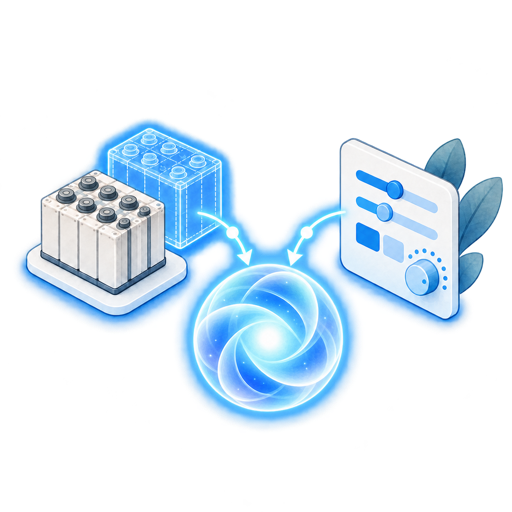
Inside the Calibration Engine
PIML Objective
ℒ(θ) = ℒdata + λ ℒphysics
Inputs
Electrical Data
Thermal Data
Operating Conditions
Physics Constraints

Studio Workspace
Start by selecting a dataset
02
Feature Identification
03
Calibrate Battery Digital Twin
0%Twin build
Select and confirm a dataset to build its digital twin
04
Synthetic Data Generation Setup
05
Synthetic Data Generation Results
Build a digital twin, adjust the setup, then generate data.
Model Library
Download reference implementations and review supported tasks, input requirements, and model assumptions. Select a model to see its details on the right.

Framework
PyTorch
scikit-learn
XGBoost
Status
Available
Experimental
Recommended
Requires GPU
Task
RUL
SOH
Type
Attention Model
Convolutional Neural Network
Ensemble
Gradient Boosting
Physics-Informed Neural Network
Recurrent Neural Network
Statistical
— models
Tasks
Dataset curation progress tracker - ETL pipeline status for each dataset across metadata, time-series, cycle summary, and QC stages.
0
Completed
0
In Progress
0
Pending
0
Skipped
| ID | Dataset | Status | Meta | Series | Summary | QC |
|---|
Naming Standard
Standardized reference naming convention for all battery datasets in the BatteryLake Benchmark. Each dataset receives a machine-readable ref_name encoding key experimental parameters.

Format pattern · Connected
BatteryLake reference name sequencer
Assembled reference name
2007_NASA_PCoE_LCO_18650_1C_1C_25T
Interaction: automatic field walkthrough; hover or focus to inspect one field.7 fields · underscore-delimited
Examples
| Dataset | ref_name |
|---|---|
| NASA PCoE | 2007_NASA_PCoE_LCO_18650_1C_1C_25T |
| Stanford-MIT-TRI | 2019_Stanford_MIT_TRI_LFP_18650_MultiC_30T |
| NTU EEE Internal | 2026_NTU_Ampace-Samsung_LFP-NMC_21700_2C_2C_25T |
| Imperial 21700 | 2024_Imperial_Kirkaldy_NMC_21700_MultiC_MultiT |
Field Vocabulary
Sources (25+)
NASA_PCoE · CALCE_UMD · Stanford_MIT_TRI · Oxford_Howey · RWTH_Aachen · NTUEEE · SNL · HNEI · UL_Purdue · XJTU · KIT · Tsinghua · CMU_Bills · Stanford_Onori · TUM · Beihang · Imperial · ISU_ILCC · EVERLASTING_4TU · Mendeley · Figshare · Zenodo ...
Chemistries
LFP · NMC · NMC811 · LCO · NCA · LiIon (generic) · MultiChem
Form Factors
18650 · 21700 · Pouch · Prismatic · Cyl · Auto · EV-BMS
Documentation
Technical reference for using the BatteryLake Benchmark datasets and evaluation framework.

Getting Started
Clone the repository and install the conda environment.
git clone https://github.com/tianwen1209/BatteryLake-Benchmark-DataPrep.git
cd BatteryLake-Benchmark-DataPrep
conda create -n batterylake python=3.10
conda activate batterylake
pip install -r requirements.txt
cd BatteryLake-Benchmark-DataPrep
conda create -n batterylake python=3.10
conda activate batterylake
pip install -r requirements.txt
Dataset Registry
All datasets are tracked in dataset_registry.csv with columns for dataset identity, DOI, source URL, assigned owner, ref_name, processing status, QC status, last update, and notes.
Evaluation
The benchmark evaluation framework uses evaluate.py and dataset_interface.py to run baseline models across selected datasets and split protocols.
About
BatteryLake Benchmark curates, standardizes, and evaluates lithium-ion battery cycling datasets from research labs worldwide, enabling fair comparison of machine learning models for state-of-health estimation and remaining useful life prediction.

Team
Research and engineering contributors
Project Supervisors
YW
Prof. Yonggang Wen
Principal Investigator
WH
Dr Wang Hao
Research Fellow
Core Researcher
ZT
Zhu Tianwen
PhD Candidate
Web Engineering
CY
Cai Yezi
Frontend Engineer
Affiliation
Nanyang Technological University
Singapore
Terms & Citation
Guidelines for using, sharing, and citing resources available through BatteryLake.

Licence
BatteryLake provides access to battery datasets, metadata, benchmarking resources, and related research materials collected from multiple sources.
Individual datasets, algorithms, and other resources may come with their own licences and citation requests. Please honour these requirements. BatteryLake will display the applicable licence and citation information whenever it is known.
Before downloading, redistributing, modifying, or using a resource, please review the licence and usage terms provided on its dataset or resource page. When source-specific terms are available, those terms take precedence over the general information provided on this page.
BatteryLake does not grant additional rights to third-party content beyond those provided by the original authors, institutions, or data owners.
Citation
If you use BatteryLake, its curated datasets, standardized outputs, benchmarking resources, or platform tools in academic work, please cite the BatteryLake paper below.
BatteryLake: Agentic, Physics-Grounded Curation of Heterogeneous Battery Aging Data and Benchmarking
BibTeX
@misc{zhu2026batterylakeagenticphysicsgroundedcuration,
      title         = {BatteryLake: Agentic, Physics-Grounded Curation of Heterogeneous Battery Aging Data and Benchmarking},
      author        = {Tianwen Zhu and Hao Wang and Yonggang Wen},
      year          = {2026},
      eprint        = {2607.09762},
      archivePrefix = {arXiv},
      primaryClass  = {cs.AI},
      url           = {https://arxiv.org/abs/2607.09762}
}
When using an individual dataset, algorithm, model, or other contributed resource, please also cite its original authors and follow any citation instructions shown on the corresponding resource page.
Citing both BatteryLake and the original resource helps ensure that the platform contributors, dataset creators, and research institutions receive appropriate credit.
Quality Assessment
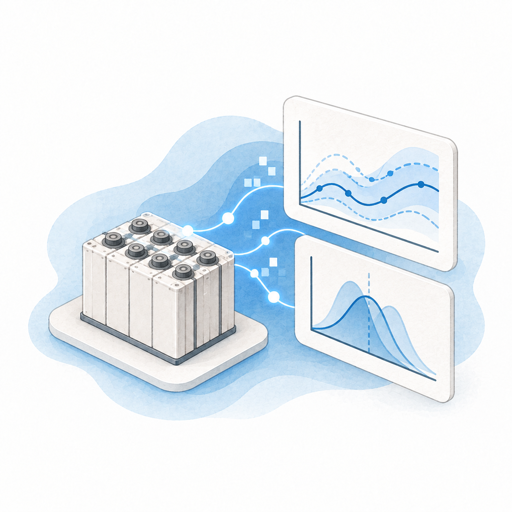
Every dataset in BatteryLake is evaluated across four key quality dimensions to ensure scientific reliability. Assessments include physical plausibility checks and detailed JSON diagnostic reports.

No file selected.
Sample CSVs to try uploading
Loading…
0.97
Completeness
Missing channels2.1%
0.95
Consistency
Sequence issues3 flags
0.92
Accuracy
Physical checks5 / 6 pass
1.00
Validity
Schema errors0
0.96
Physical Plausibility Checks
High-signal checks that determine whether a dataset can safely enter preprocessing and benchmark training.
-
Voltage Range ValidationAll cell voltages within 2.0V-4.5V nominal operating range for the stated chemistry.
-
Energy Balance CheckCharge/discharge energy integral consistency; coulombic efficiency remains within 95-105% per cycle.
-
Capacity MonotonicityDegradation trajectory follows expected non-increasing trend with allowable recovery windows.
-
Temperature ConsistencyCell surface temperature must remain within 5°C of stated test condition; one dataset needs review.
-
Timestamp IntegrityMonotonically increasing timestamps with no negative intervals or unreasonable gaps above 24h.
-
Current Direction ConsistencyCharge and discharge current signs follow one convention throughout the dataset.
Diagnostic Output
quality_report.json
{
  "dataset_id": "dataset_03",
  "quality_score": {
    "completeness": 0.97,
    "consistency": 0.95,
    "accuracy": 0.92,
    "validity": 1.00
  },
  "overall": 0.96,
  "gate": "ready_with_warning",
  "checks": [
    { "name": "voltage_range", "passed": true },
    { "name": "temperature_consistency", "status": "review" },
    { "name": "capacity_mono", "passed": true }
  ],
  "generated_at": "2026-04-28T12:00:00Z"
}
Preprocessing
Turn a raw battery dataset into the BatteryLake v2.0.0 standard with one agent skill: provenance-preserving canonical data, explicit SOH / RUL task views, and auditable validation reports.

01Set Up the Processing Skill
01
Download the skill package
Save batterylake-processing.zip to your BatteryLake data repository.
See package contents
02Choose a Dataset and Send the Prompt to Your Agent
-
01Choose a datasetin
Raw_Dataset/…outProcessed_Dataset/… -
02Paste the prompt to your agent
The agent reads the standard and the dataset TODO, then continues from the first unfinished gate.
-
03Watch it work
-
Progress lives in
status.jsonone line per gate, plusTODO.md - Interrupted runs resumefinished steps are skipped when fingerprints match
- Raw files stay untouchedundecodable data is reported, never invented
-
Progress lives in
While processing, your agent runs these five checks
- InventoryList every file and archive member, hash each source.inventoried
- SemanticsConfirm cells, units, clocks, cycle boundaries and labels.adapter design confirmed
- ConversionWrite every source field to the canonical layer.converted
- FidelityCompare raw and standard values record by record.canonical_validated
- EquivalenceRaw and standard loaders train to the same result.benchmark_verified



Your agent produces these files and follows these rules
What the skill produces
click an item
Rules the skill never skips
click to expand
-
Identify files by content
Magic bytes, complete payloads and EOF are checked. A
.pklmay hold several streams; extensions are only a hint. - No cleaning in the fidelity layer No resampling, interpolation, clipping, float32 down-casting or dropped diagnostics. Those belong to a named task view.
- Capacities are not interchangeable Health capacity, partial-DoD throughput, RPT capacity, rated capacity and author SOH stay separate. Unclear labels are withheld, not guessed.
- EOL is an observed event The last row is not EOL. Sparse RPTs may only bound an interval, and right-censoring is recorded instead of a fake RUL.
- No leakage across splits The same physical cell, duplicate copies and overlapping windows stay on one side; scalers are fit on training data only.
-
Gates advance only with evidence
inventoried,converted,canonical_validatedandbenchmark_verifiedare separate; none is inferred from the one before.
03Upload status.json to Check Benchmark Readiness
Try a real one:
Example
dataset_21
needs_semantic_review
Platform APIs & Applications
Access open APIs for data download and benchmarking, or develop end-to-end applications with feature engineering and model interpretation on the BatteryLake platform.

Developer console
Explore endpoints as a working platform surface, not a brochure.
Choose a route from the library, inspect its parameters, preview the request, then run a simulated call to see the exact response shape the platform returns.
Live routes0
Formats0
Auth modeToken
Dataset catalog endpoint
Designed for search, filtering, and benchmark preparation. The response returns only datasets that pass the required ETL and quality gates.
GET/v1/datasets?chemistry=LCO&quality=ready
chemistryLCO | LFP | NMC
formatCSV | Parquet
split_readytrue
dataset_id
cell_count
cycle_count
quality_score
response · application/json200 OK
Application workbench
Applications are grouped by what the user is trying to do, not by abstract product names.
BenchmarkExperiment Builder
Pick datasets, split cells, select models, and run comparable SOH/RUL benchmarks.
FeaturesFormula Studio
Upload custom signal formulas and compute cycle-level model inputs from raw curves.
ExplainInterpretation Lab
Inspect feature importance, attention maps, and degradation signals after training.
Open API
Data Download API
Access harmonized, quality-assessed datasets via RESTful endpoints with embedded citations, metadata, and provenance tracking.
- RESTful endpoints for dataset listing and download
- Parquet, CSV, and JSON export formats
- Embedded DOI citations and provenance
- Selective cell/cycle range queries
Open API
Benchmark API
Run standardized ML benchmarks across curated datasets with reproducible train/val/test splits and unified evaluation metrics.
- SOH estimation and RUL prediction tasks
- 5+ baseline models (LR, RF, XGBoost, LSTM, Transformer)
- Random, temporal, and cross-cell split protocols
- RMSE, MAE, MAPE unified metric suite
Coming Soon
Feature Engineering
Build custom feature extraction pipelines with interactive notebooks. Extract dQ/dV features, health indicators, and domain-specific signals for advanced analytics.
- dQ/dV peak detection and tracking
- Health indicator extraction (IC, DV)
- Statistical feature pipeline
- EIS parameter fitting
Coming Soon
Model Interpretation
Understand model predictions with explainability tools. Visualize attention maps, feature importance, and identify key battery aging patterns driving predictions.
- SHAP feature importance analysis
- Attention map visualization
- Gradient-based attribution
- Integrated gradients for deep models
Platform Roadmap
Data Download API
Available
Open API — harmonized dataset access with provenance and citations.
Benchmark API
In Progress
Open API — reproducible SOH / RUL experiment execution.
Feature Engineering
Planned
End-to-end application — dQ/dV, health indicators, formula features.
Model Interpretation
Planned
End-to-end application — SHAP, attention maps, attribution.
Contribute a dataset
Three steps: describe the dataset, point us to the raw files, submit. The team then runs the batterylake-processing skill on your files and publishes the dataset with your attribution.

- 01Describe0 / 12 required fields
- 02Raw datano link yet
- 03Submit0 / 5 ready
01
Describe the dataset
Only what the catalog needs and what the processing skill needs to convert your files. Your draft stays in this browser.
Dataset metadata
For the processing skill
02
Provide the raw data
Host the original cycler exports where the team can download them and paste the link. Keep the original file names; do not resample or clean.
Checking the upload service…
Drop files or a folder here
Any format your cycler exports: CSV, Excel, MATLAB, Parquet, HDF5, zip… Keep the original names.
03
Submit
Opens a GitHub issue prefilled with your metadata, notes, checklist and data link; attach nothing else. The team takes it from there.
After submission the team runs the batterylake-processing skill on your files. You get a status.json and a quality report, and the dataset appears in the catalog under your reference name with your DOI and license.